



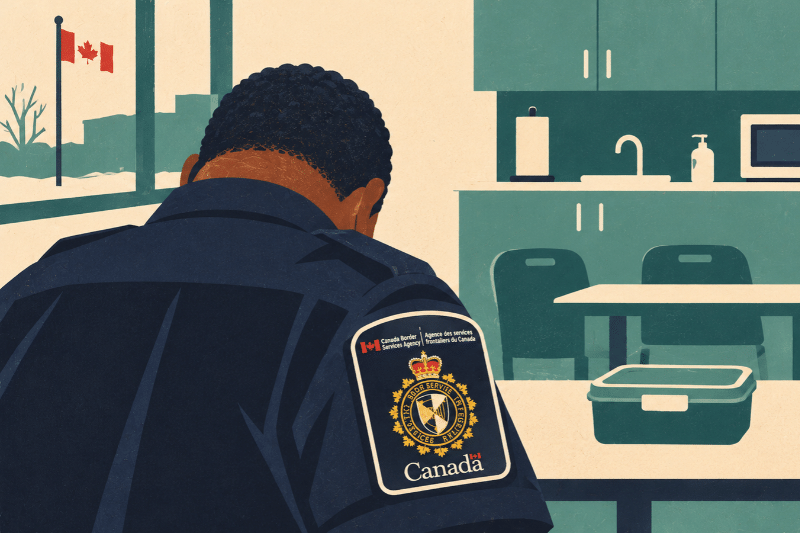
In a performance file at the Canada Border Services Agency, there is a sentence about a trainee who was struggling to fit in at the Pacific Highway port of entry near Surrey, B.C.
It reminds him that officers on a four-on, four-off schedule spend half the year at work. “We are, by default, a family,” it continues, before citing studies on the productivity benefits of workplace friendship.
The trainee was a Black man of Nigerian origin who arrived at the port in August 2021. In 2022, the agency rejected him on probation. In August, the Federal Public Sector Labour Relations and Employment Board found that discrimination and bad faith were factors in that decision and allowed his grievances. We don’t know the remedy yet, as that is still to come.
The “family” had some habits. According to evidence nobody contradicted, officers mimicked his voice on the radio and compared his accent to a croaking frog. They mocked his food, his appearance and the way his uniform fit across his chest. His field coach announced at the communal desk, within easy earshot of supervisors’ offices, that he was “the worst recruit of the bunch.”

He said this at a point when the superintendent who wrote his first assessment considered his performance ordinary. When the trainee radioed for someone to cover his post so he could use the washroom, nobody came. When he finally went, an officer teased him about his visible discomfort, and his supervisor radioed to berate him while he was still inside. The adjudicator, Edith Bramwell, observed that children in a schoolyard are held to a higher standard.
Chastised for not socializing
His managers, meanwhile, had a concern: he didn’t socialize enough. The point appeared in his first assessment and got sharper with each one after. He sat alone. He didn’t join conversations. Colleagues said their efforts to welcome him had “fallen flat.” One superintendent coached him on small talk, with kids and hobbies as suggested common ground.
She also told the board he was an introvert just like her husband, and that if her husband could make the effort, anyone could. In testimony she described him as “lovely,” several times, sometimes in a single sentence. He was also sent to a session on emotional triggers. Nobody could say what had triggered it, and there was no record of an outburst.
The family metaphor is a common one in workplaces. Managers sound warm and employees are told they belong. It subtly promises the obligations of kinship while keeping all the rights of an employer. (Spot a problem here?)
Workplaces versus families
Real families have plenty of flaws, but they lack certain features of a workplace. You cannot fire your sister. You do not reprimand your niece for a missed deadline or put your brother-in-law on a PIP. Nobody fills out a quarterly questionnaire on your contribution to Thanksgiving dinner. Kinship is unconditional by design. Employment is conditional by design, and probation is its most conditional stage. A trainee on probation can be shown the door at any point. Telling him he is family is not a welcome. It is akin to a performance standard.
That is what it became here. Bramwell noted that the agency’s trainee handbook expects trainees to take part in “learning conversations” and nowhere requires friendship, adding that it would be bizarre if it did. Collegial working relationships are a fair expectation. Socializing with people who imitate your accent is another matter.
How anyone could build positive professional relationships with people who had repeatedly insulted his personal characteristics, she wrote, “is a far greater challenge to understand.”
Supervisors knew about at least some of the mockery. In that setting, she found, the relentless emphasis on socializing created a requirement he could not meet, and it compounded the discrimination.
When discrimination is ‘normal’
None of this is unique to a border crossing. A group freezes a new hire out, and he keeps his distance, as most people do when they’re the joke. His managers see him keeping to himself, but they don’t see the joking, so his file says he doesn’t engage and says nothing about why. Bramwell saw this as typical of a workplace where discrimination has become normal: people call it harmless teasing, or they blame the person on the receiving end by telling him he should socialize more or should have complained sooner.
One superintendent told the board that “people make fun of accents all the time.”
The trainee did speak up. He emailed the regional liaison about “work-related incidents.” The reply referred him to the employee assistance program and copied in his superintendent. A colleague raised race-based harassment with the port’s chief of operations, who told her every officer had a duty to report such things and then did nothing. A union officer raised it twice more. The chief’s email summarizing their call said that without details, he “was not sure what I should be looking into.”
He had not asked for any. Bramwell found that he deliberately misled the union about an investigation. She also found that a year after the termination, the agency set about documenting that the concerns had been dealt with.
Nobody in this story needed to be family. They needed to be colleagues: to stop the laughing, to coach the trainee they were assigned, and to ask a follow-up question when someone used the word racism. Instead, his coach told another officer, “We’re not helping him anymore.” And yet, those are the obligations the workplace actually had.
The family language had one practical use. It let managers read a man’s distance from his tormentors as a failure to belong, not as an accurate measure of what belonging there would have cost him.