



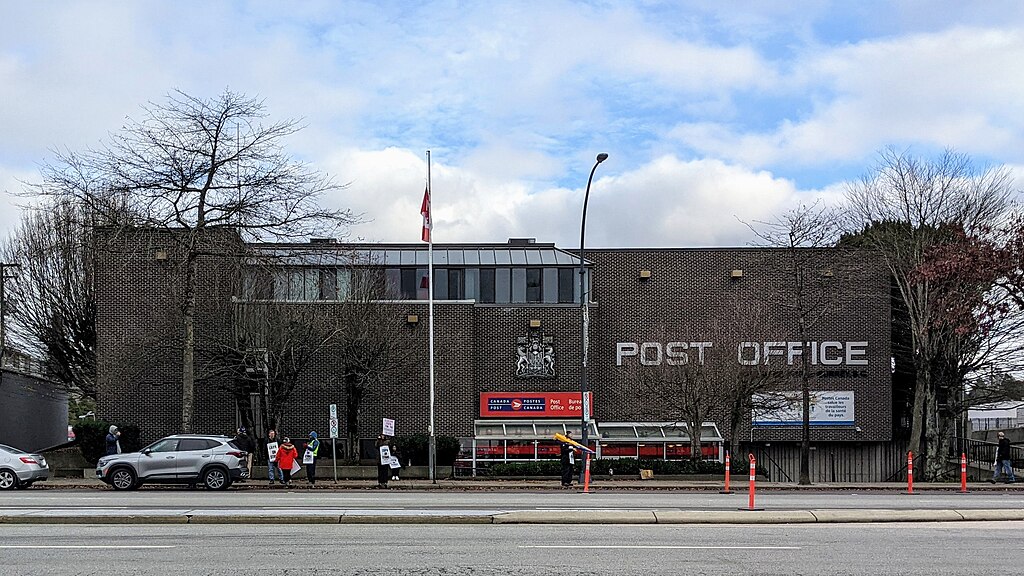
The Ontario Court of Appeal has ruled it has jurisdiction to hear a union’s appeal of injunctions that barred secondary picketing at a Purolator facility during a Canada Post strike, rejecting the company’s argument that the appeal should go to a lower court.
The Canadian Union of Postal Workers was conducting a lawful nationwide strike against Canada Post Corporation in November 2024 when members began picketing outside a Purolator pickup and delivery facility in Scarborough. Canada Post is the majority shareholder of Purolator, but Purolator employees were not on strike as they are represented by a different union.
On Nov. 29, 2024, the picketers began blocking access to and exit from the Silver Star Boulevard facility, causing significant delays. Only 27 of 78 planned Purolator vehicles were able to leave that day. The company successfully obtained an emergency injunction the same day, which was extended through a series of orders until Dec. 16, 2024.
CUPW appealed the injunctions to the Court of Appeal, but Purolator sought to have the appeal quashed, arguing it should go to the Divisional Court instead because the injunctions were interlocutory orders made under section 101 of the Courts of Justice Act.
The union argued the injunctions fell under section 102 of the act, which governs labour disputes and provides different procedural protections and appeal routes. Under section 102, appeals go directly to the Court of Appeal without requiring leave.
Motion judge applied wrong legal test
The motion judge who granted the original injunctions ruled that section 102 did not apply because “there is no labour dispute between Purolator and the picketers.” The judge found the secondary picketing was not “picketing in relation to a labour dispute” under section 102.
However, the Court of Appeal disagreed with this interpretation. In a 2-1 majority decision, the court found that section 102’s definition of “labour dispute” encompasses secondary picketing.
The court noted that section 102 defines a labour dispute as one concerning employment terms “regardless of whether the disputants stand in the proximate relation of employer and employee.” The court said this phrase “expressly mandates that it applies regardless of whether the disputants stand in the proximate relationship of employer and employee.”
Legislative history supports broader interpretation
The Court of Appeal examined the legislative history behind section 102, finding that the phrase about disputants not needing to be in an employer-employee relationship was added in 1970 following recommendations from the Rand Report on labour disputes.
The court noted that explanatory notes from the 1970 amendment stated the expanded definition was intended “to include disputes and differences in a labour context whether or not there is an actual employer-employee relationship existing between the contestants” and to provide “uniformity of procedure for obtaining injunctive relief in all labour disputes.”
The court also referenced the Supreme Court of Canada’s decision in Pepsi-Cola, which found that secondary picketing is generally lawful unless it involves tortious or criminal behaviour. That decision “flatly rejects the distinction between primary and secondary picketing, noting that it is ‘a difficult and arbitrary distinction that deserves to be abandoned,'” the Court of Appeal said.
Section 102 provides additional protections
The Court of Appeal noted that section 102 provides additional procedural protections for labour-related picketing that are not available under section 101. These include requirements for notice before seeking an injunction, limits on interim injunctions to four days, and specific notice requirements.
The court found these protections should apply to secondary picketing as well as primary picketing, given the legislative intent to treat all labour disputes uniformly.
Dissenting judge disagrees on jurisdiction
Justice Gomery dissented, arguing the Court of Appeal lacked jurisdiction because the motion judge explicitly made the orders under section 101, not section 102.
The dissenting judge said the court’s jurisdiction is statutory and section 102’s appeal route “is only available in respect of an order made under s. 102.” Since the motion judge “explicitly declined to make such an order,” the appeal should go to the Divisional Court.
Justice Gomery also argued that determining which appeal route applies “does not depend upon whether the decision being appealed from is correct or not” but rather “the nature of the order being appealed from.”
Practical implications for employers
The decision means that when unions engage in secondary picketing during labour disputes, employers seeking injunctions must generally follow the more restrictive procedures under section 102 of the Courts of Justice Act rather than the general injunction provisions in section 101.
This includes providing notice to the union before seeking an injunction, except in exceptional circumstances, and accepting that interim injunctions are normally limited to four days rather than longer periods.
The ruling also confirms that appeals from such injunctions go directly to the Court of Appeal without requiring leave, potentially making it easier for unions to challenge restraining orders.
For more information, see Purolator Inc. v. Canadian Union of Postal Workers, 2025 ONCA 565 (CanLII).